
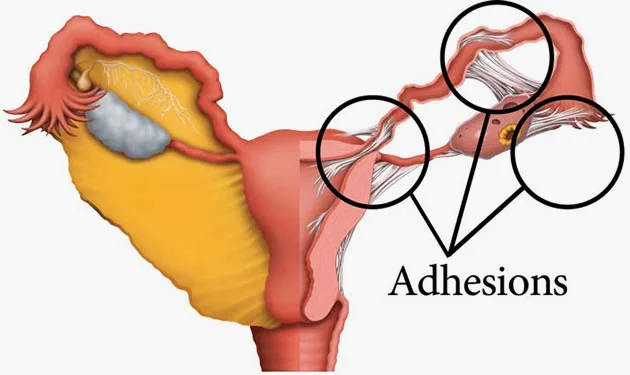
What Are Adhesions?
Adhesions are tough, fibrous scar tissues that form between internal organs, causing them to stick together. Normally, organs move freely inside the abdomen, but adhesions act like “internal glue,” restricting movement and sometimes pulling organs into abnormal positions.
Although many adhesions do not cause symptoms, some lead to significant problems such as abdominal pain, infertility, pelvic pain, or intestinal blockage.
Common Areas Where Adhesions Form
Abdomen
Pelvic region (uterus, ovaries, fallopian tubes)
Intestines
Bladder
Surgical sites
Causes of Adhesions
1. Previous Surgeries
The most common cause is abdominal or pelvic surgery. Procedures such as:
C-section
Hysterectomy
Appendectomy
Gallbladder removal
Bowel surgery
All increase the risk of adhesion formation as part of the normal healing process.
2. Infections
Conditions like:
Pelvic Inflammatory Disease (PID)
Appendicitis
Peritonitis
can damage tissue and lead to scar formation.
3. Endometriosis
Endometrial tissue outside the uterus creates inflammation, which may cause organs to stick to each other.
4. Abdominal/Pelvic Trauma
Accidents or injuries can trigger scar tissue.
5. Radiation Therapy
Radiation causes tissue damage, increasing adhesion risks.
Symptoms of Adhesions
While some patients remain symptom-free, many experience discomfort and complications such as:
1. Chronic Abdominal or Pelvic Pain
Adhesions pull on organs, leading to long-term and sometimes severe pain.
2. Bowel Obstruction
Adhesions can block the intestine, causing:
Nausea
Vomiting
Constipation
Inability to pass gas
Severe abdominal swelling
This is a medical emergency.
3. Infertility
Pelvic adhesions on:
Fallopian tubes
Ovaries
Uterus
can prevent natural conception by disrupting egg transport or blocking the tubes.
4. Pain During Intercourse
Pelvic adhesions may cause deep dyspareunia (painful intercourse).
5. Menstrual Irregularities
Women may experience painful cycles or irregular bleeding due to restricted reproductive organs.
6. Difficulty with Digestive Function
Adhesions may cause bloating, cramping, or altered bowel habits.
If these symptoms interfere with daily life, medical evaluation at Sparsh Hospital is essential.
Diagnosis of Adhesions at Sparsh Hospital
Adhesions are often difficult to see on routine imaging; however, our specialists use a combination of:
1. Detailed History & Physical Examination
Understanding previous surgeries and symptoms.
2. Ultrasound & Pelvic Scan
Helps evaluate internal organ mobility and abnormalities.
3. MRI / CT Scan
Useful in identifying secondary complications like bowel obstruction.
4. Diagnostic Laparoscopy
The gold standard.
A small camera is inserted to directly visualize adhesions and, if necessary, remove them during the same procedure.
At Sparsh Hospital, advanced laparoscopic units ensure precise diagnosis and fastest-possible recovery.
Adhesion Removal (Adhesiolysis) at Sparsh Hospital
Adhesiolysis is a surgical procedure to cut, separate, and remove scar tissue so organs can move freely again. It is performed either laparoscopically, hysteroscopically, or through open surgery (rare).
1. Laparoscopic Adhesion Removal
This is the most preferred and advanced option at Sparsh Hospital.
How It Works
Small keyhole incisions are made.
A high-definition laparoscopic camera is inserted.
Specialized micro-instruments gently separate or remove the adhesions.
Organs are restored to their natural positions.
Benefits of Laparoscopic Adhesiolysis
Minimal pain
Faster recovery
Less bleeding
Shorter hospital stay
Lower risk of new adhesions
Better cosmetic results
Ideal For:
Abdominal pain
Pelvic pain
Post-surgical adhesions
Fertility issues
Bowel adhesions
2. Hysteroscopic Adhesion Removal
This is used for uterine adhesions (Asherman’s Syndrome).
Procedure
A hysteroscope (a thin camera) is inserted through the vagina—no incisions.
Adhesions inside the uterus are gently cut.
The uterine cavity is restored to normal shape.
Benefits
No cuts on the abdomen
Improves menstrual flow
Enhances fertility
Quick recovery
Perfect For Women With:
Light or absent periods
Infertility
Uterine scarring after D&C, miscarriage, or infection
3. Open Adhesion Removal Surgery
Used only in extreme or emergency cases, such as:
Severe bowel obstruction
Extensive adhesions
Sparsh Hospital prioritizes minimally invasive methods but provides open surgery when necessary.
Recovery After Adhesion Removal at Sparsh Hospital
Recovery depends on the type of procedure, severity of adhesions, and overall health.
Typical Recovery Timeline
Laparoscopic: 2–7 days for basic activities
Hysteroscopic: 1–3 days
Open surgery: 3–6 weeks
Post-operative Care
Pain medications as prescribed
Light diet initially
Avoid heavy lifting for 2–3 weeks
Hydration to improve bowel function
Antibiotics (if recommended)
Follow-up ultrasound or scan (if required)
Our team provides complete guidance and personalized recovery plans for each patient.
Why Choose Sparsh Hospital for Adhesion Removal?
1. Expert Surgeons
Sparsh Hospital houses highly qualified laparoscopic and hysteroscopic surgeons with vast experience in complex adhesiolysis.
2. Modern Minimally Invasive Technology
We use:
HD laparoscopic cameras
3D visualization systems
Ultrasonic energy devices
Advanced hysteroscopes
ensuring precision and minimal tissue damage.
3. Personalized Patient Care
Each case is evaluated individually based on:
Symptoms
Surgery history
Fertility needs
Pain severity
This ensures the safest and most effective treatment.
4. High Success Rates
From pain relief to fertility improvement, our outcomes are consistently excellent.
5. Faster Recovery & Less Pain
Minimally invasive options mean patients return to their routine sooner.
6. Complete Women’s Care & Abdominal Care Under One Roof
Our team includes:
Laparoscopic surgeons
Gynecologists
Gastro specialists
Fertility experts
All collaborating for the best results.