
Advanced IVF Care with Compassion, Precision & Hope
What is Frozen Embryo Transfer (FET)?
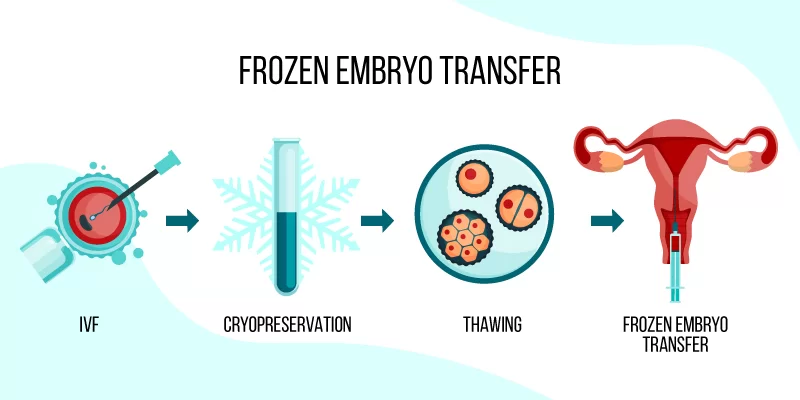
Frozen Embryo Transfer (FET) is a specialized procedure in In Vitro Fertilization (IVF) where embryos created during a previous IVF cycle are cryopreserved (frozen) and later thawed and transferred into the woman’s uterus. Instead of transferring embryos immediately after egg retrieval, FET allows embryos to be transferred in a future menstrual cycle when the uterus is optimally prepared.
As a result, FET offers greater flexibility, improved implantation rates, and reduced physical stress on the woman’s body.
Why is FET Performed?
Frozen Embryo Transfer is recommended for many reasons. At Sparsh Hospital, our fertility experts carefully evaluate each patient before suggesting FET.
Common Reasons for FET:
To give the body time to recover after egg retrieval
To reduce the risk of Ovarian Hyperstimulation Syndrome (OHSS)
When genetic testing (PGT) of embryos is required
For patients with irregular hormone levels
To plan pregnancy at a later time
For fertility preservation before cancer treatment
After a failed fresh IVF cycle
Therefore, FET is often considered a safer and more controlled approach compared to fresh embryo transfer.
Benefits of Frozen Embryo Transfer
Frozen Embryo Transfer offers several medical and emotional advantages.
Key Benefits:
Higher implantation success rates in many cases
Better uterine environment for embryo implantation
Lower risk of OHSS
Less hormonal stress on the body
Flexible treatment planning
Reduced cost compared to starting a new IVF cycle
Increased chance of future pregnancies from the same IVF cycle
Consequently, many couples prefer FET for its safety, convenience, and effectiveness.
Frozen Embryo Transfer Process at Sparsh Hospital
At Sparsh Hospital, we follow a structured, transparent, and patient-centric approach for FET treatment.
Step 1: Embryo Freezing (Cryopreservation)
During an IVF cycle, healthy embryos are selected and frozen using vitrification, an advanced rapid-freezing technique that preserves embryo quality and survival rates.
Step 2: Endometrial Preparation
Before embryo transfer, the uterine lining must be prepared for implantation. This can be done in two ways:
1. Natural Cycle FET
Suitable for women with regular menstrual cycles
Ovulation occurs naturally
Embryo transfer is timed accordingly
2. Hormone-Replacement Cycle FET
Estrogen and progesterone medications are used
Ideal for women with irregular cycles
Allows precise control of timing
At Sparsh Hospital, we select the best method based on individual medical needs.
Step 3: Monitoring & Evaluation
During this phase:
Ultrasounds monitor endometrial thickness
Blood tests check hormone levels
The uterus is assessed for optimal readiness
Once conditions are ideal, the embryo transfer is scheduled.
Step 4: Thawing the Frozen Embryo
On the day of transfer:
Frozen embryos are carefully thawed
Only embryos with excellent survival and quality are selected
Advanced lab protocols ensure high success rates
Step 5: Embryo Transfer Procedure
The embryo transfer is:
Painless and non-surgical
Performed using ultrasound guidance
Completed within a few minutes
Does not require anesthesia
After the procedure, the patient can return home the same day.
Step 6: Pregnancy Test
Approximately 10–14 days after embryo transfer, a blood test (beta hCG) is done to confirm pregnancy.
Success Rate of Frozen Embryo Transfer
With modern techniques, FET success rates are comparable or even higher than fresh embryo transfer.
Factors Affecting FET Success:
Woman’s age
Embryo quality
Endometrial thickness
Hormonal balance
Underlying fertility issues
Lifestyle and overall health
At Sparsh Hospital, our high success rates are achieved through:
Advanced embryology labs
Skilled fertility specialists
Individualized treatment planning
Evidence-based protocols
Who is an Ideal Candidate for FET?
Frozen Embryo Transfer may be ideal for:
Women with PCOS
Patients at risk of OHSS
Couples planning delayed pregnancy
Cancer patients preserving fertility
Women with uterine or hormonal issues
Patients with previously frozen embryos
Our fertility experts at Sparsh Hospital thoroughly assess each case before recommending FET.
Frozen Embryo Transfer vs Fresh Embryo Transfer
| Aspect | Frozen Embryo Transfer | Fresh Embryo Transfer |
|---|---|---|
| Timing | Flexible | Immediate |
| Hormonal Stress | Lower | Higher |
| Uterine Readiness | Better controlled | May be affected |
| OHSS Risk | Low | Higher |
| Success Rate | High | Variable |
Is Frozen Embryo Transfer Safe?
Yes, FET is considered extremely safe. Research shows that babies born through frozen embryo transfer are just as healthy as those conceived naturally or via fresh IVF cycles.
At Sparsh Hospital:
International safety protocols are followed
Embryos are stored securely
Strict quality control measures are maintained
Emotional Support During FET Treatment
We understand that fertility treatment is not only physical but also emotional. Therefore, Sparsh Hospital provides:
Compassionate counseling
Clear communication
Emotional and psychological support
Guidance at every stage of treatment
Our team walks with you throughout your fertility journey.