
Understanding Azoospermia and Male Infertility
Azoospermia is a condition where no sperm is found in the ejaculate. It affects nearly 1% of the male population and around 10–15% of infertile men. There are two types:
1. Obstructive Azoospermia (OA)
Sperm is produced normally in the testes but cannot reach the ejaculate due to a blockage. Common causes include:
Vasectomy
Congenital absence of vas deferens
Infection
Trauma
Previous surgeries
2. Non-Obstructive Azoospermia (NOA)
The testes produce very few or no sperm due to:
Genetic abnormalities
Hormonal imbalance
Testicular failure
Varicocele
Exposure to toxins, radiation, or chemotherapy
In both conditions, sperm retrieval techniques like TESE, TESA, and PESA offer hope.
TESE, TESA & PESA at Sparsh Hospital
1. TESA – Testicular Sperm Aspiration
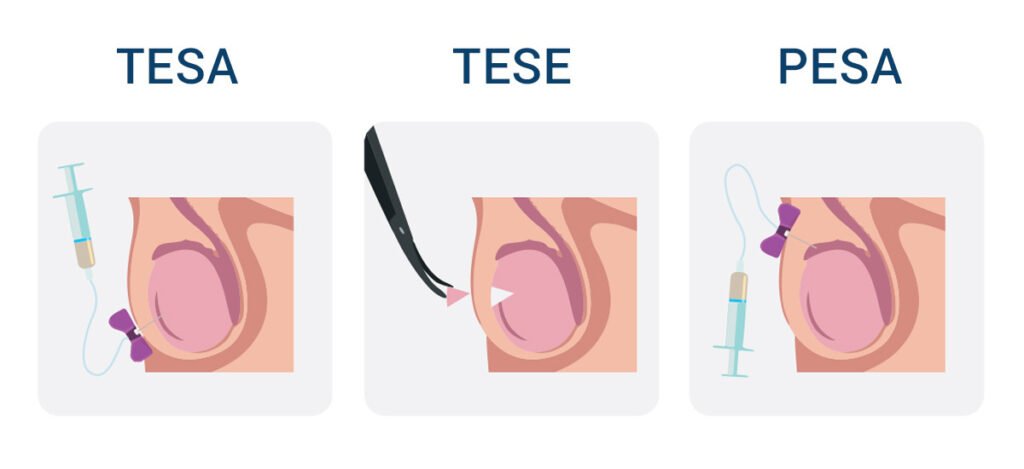
TESA is a minimally invasive procedure used to extract sperm directly from the testicular tissue.
How TESA Works
Performed under local anesthesia
A fine needle is inserted into the testis
Small pieces of testicular tissue are aspirated
Sperm are isolated in the lab and used for ICSI
Who Benefits from TESA?
Men with non-obstructive azoospermia
Those with severely low sperm count
Men who need sperm retrieval for ICSI due to failed ejaculation
Advantages of TESA
Quick (10–15 minutes)
Minimal discomfort
No incision required
Fast recovery
2. TESE – Testicular Sperm Extraction
TESE is a slightly more invasive but highly effective surgical technique used when TESA fails or when sperm production is extremely low.
How TESE Works
Performed under local or general anesthesia
A small incision is made in the scrotal skin
Tiny testicular tissue samples are removed
Embryologists isolate healthy sperm
Who Needs TESE?
Men with non-obstructive azoospermia
Patients with genetic or hormonal issues affecting sperm production
Cases where TESA does not yield sperm
Benefits of TESE
Higher sperm retrieval rate
Suitable for difficult cases
Tissue can be frozen for future use
Helps couples avoid donor sperm
3. PESA – Percutaneous Epididymal Sperm Aspiration
PESA is a widely used technique for men with obstructive azoospermia, especially after vasectomy or congenital blockage.
How PESA Works
Performed under local anesthesia
A fine needle is inserted into the epididymis
Fluid containing sperm is aspirated
Sperm are processed for ICSI
Ideal Candidates for PESA
Men with blocked vas deferens
Men with failed vasectomy reversal
Those with obstructive azoospermia caused by infection or injury
Advantages of PESA
Simple and quick
No surgical incision
High-quality motile sperm retrieval
Can be repeated if needed
Why Choose Sparsh Hospital for TESE/TESA/PESA?
✔ Experienced Fertility & Andrology Team
Our specialists have extensive experience diagnosing and treating male infertility, offering the highest success rates in sperm retrieval.
✔ State-of-the-Art IVF & ICSI Laboratory
We use advanced microscopes, micro-manipulators, and controlled lab environments to ensure the best chance of fertilization.
✔ Personalized Treatment Plans
Every couple receives a customized fertility roadmap based on medical history, diagnosis, and emotional needs.
✔ Advanced Embryology Expertise
Our embryologists are trained in precise sperm selection, micro-injection, and cryopreservation techniques.
✔ High Success in Difficult Cases
Even in cases of severe azoospermia, we have achieved remarkable results with TESE/TESA/PESA combined with ICSI.
✔ Comfort, Privacy & Compassion
Your privacy and comfort are our top priorities. All procedures are done in a safe, sterile, and supportive environment.
Detailed Step-by-Step Process at Sparsh Hospital
1. Consultation and Diagnosis
Detailed semen analysis
Hormonal evaluation (FSH, LH, Testosterone)
Genetic tests if required
Physical examination
Scrotal ultrasound
We identify the exact reason behind infertility to plan the best treatment.
2. Choosing the Right Retrieval Technique
Based on diagnosis:
TESA/TESE → non-obstructive azoospermia
PESA → obstructive azoospermia
3. Procedure Day
The procedure takes 10–30 minutes
Local anesthesia ensures minimal pain
The patient can go home the same day
4. Laboratory Processing
Our embryologists:
Examine retrieved tissue
Isolate viable sperm
Store or use sperm for ICSI the same day
5. ICSI Fertilization
A single healthy sperm is injected into each egg
Embryo development is monitored for 3–5 days
6. Embryo Transfer
A high-quality embryo is transferred into the uterus
Pregnancy test is done after 14 days
Success Rates of TESA/TESE/PESA at Sparsh Hospital
Success depends on:
Type of azoospermia
Age of the female partner
Sperm quality
Lab technology
Typical success rates at Sparsh Hospital:
TESA: 35–55% sperm retrieval success
TESE: 50–70% sperm retrieval success
PESA: 90–95% success in obstructive cases
ICSI fertilization rate: 70–80%
Pregnancy success rate: varies 50–65% depending on age
Our advanced techniques and expertise greatly improve the chances of conception even in challenging cases.
Recovery & Aftercare
After TESA/PESA
Mild discomfort for 24–48 hours
Resume normal activities in 1–2 days
Ice pack recommended
After TESE
Slight swelling or soreness for 2–3 days
Avoid heavy lifting for a week
Pain medication if required
Full recovery is quick, and complications are rare.